
Strategic by Nature • Clinical at Core
A Systemic View of
Hemorrhage Control
The AAJT-S introduces a new point of control in hemorrhage response—enabling external aortic compression, junctional hemorrhage control, or pelvic stabilization depending on the clinical need, across EMS, military, and hospital environments.
Multi-functional Bleeding Control
Abdominal
Axilla
Inguinal
Pelvic Fractures
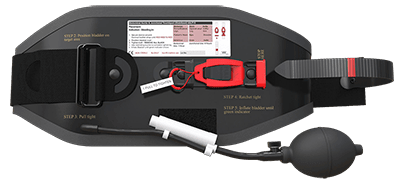

AAJT-S Overview
The AAJT-S was born from firsthand experience on the battlefield. Dr. John Croushorn, an emergency physician and special operations veteran, recognized a critical gap in hemorrhage control while serving in Iraq — particularly for severe abdominal and junctional bleeding.
At the time, there was no practical external option for abdominal aortic compression during evacuation and prolonged transport. In combat environments, Dr. Croushorn relied on manual compression techniques to temporarily slow catastrophic hemorrhage. Drawing from those experiences, he developed a stabilized external solution designed to bring that capability into the field in a more controlled and transportable form. Compression Works was founded on that mission.
The AAJT-S is indicated for use on the abdomen, inguinal, axilla, and for pelvic fracture stabilization. Its wide inflatable bladder, ratcheting strap system, integrated pressure gauge, and built-in pressure regulation are designed to deliver broad, controlled external compression in locations conventional extremity tourniquets cannot address. From tactical combat casualty care and mass casualty incidents to rural EMS and prolonged transport scenarios, the AAJT-S provides providers with an additional option when traditional methods may be limited. Backed by more than 70 peer-reviewed publications and deployed across more than 20 countries, the AAJT-S continues to support hemorrhage response across military, prehospital, and hospital environments.